Introduction
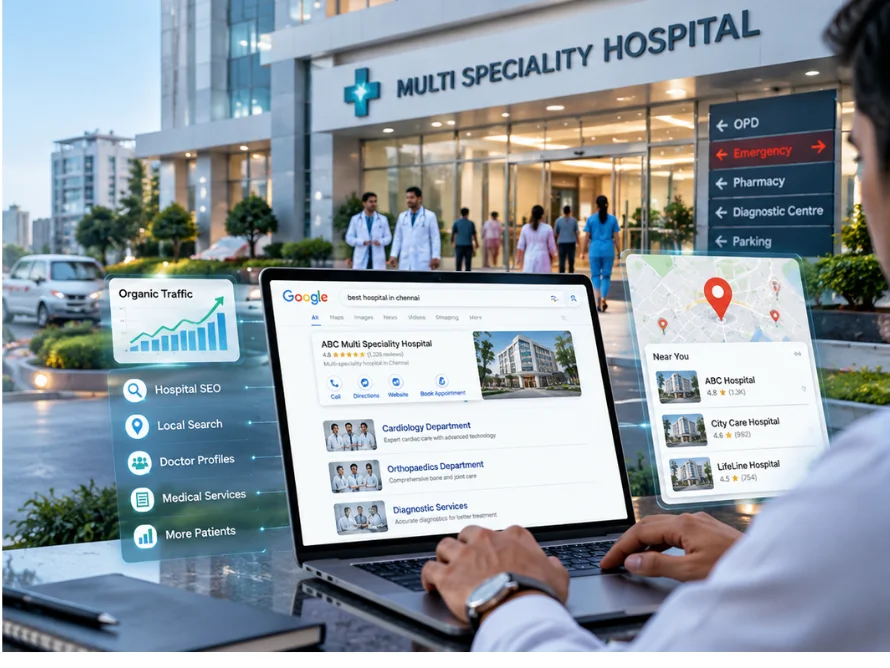
In today’s digital-first healthcare environment, patients often search online before choosing a hospital, doctor, diagnostic centre, or healthcare service. Searches such as “best hospital near me,” “cardiologist in Chennai,” “emergency hospital near me,” and “best hospital for diabetes treatment” can directly influence where patients seek care.
For hospitals, having a website is no longer enough. A well-planned hospital SEO strategy can improve search visibility, attract relevant patients, build online authority, and generate more enquiries and appointments.
Here are the top 10 SEO strategies for hospitals that can strengthen their online presence.
1. Build Dedicated Pages for Medical Services
One of the most important hospital SEO strategies is creating dedicated pages for every major medical service.
Instead of placing all services on one page, create individual, informative pages such as:
- Cardiology
- Orthopaedics
- Neurology
- Gynaecology
- Paediatrics
- General Surgery
- Emergency Care
- Diagnostic Services
Each page should clearly explain the treatment, symptoms, procedures, doctors involved, facilities, and frequently asked questions.
This helps search engines understand the hospital's expertise and allows individual services to rank for relevant searches.
2. Optimise for Local SEO
Healthcare searches are highly location-driven. Patients frequently search for hospitals and doctors in specific cities, neighbourhoods, and nearby locations.
Hospitals should optimise for keywords such as:
“hospital in Chennai,” “multispeciality hospital in Chennai,” “hospital near Nungambakkam,” or “orthopaedic hospital near me.”
Optimise the hospital's Google Business Profile with accurate:
- Hospital name
- Address
- Phone number
- Website
- Working hours
- Services
- Photos
- Categories
Consistent NAP (Name, Address, Phone Number) information across directories can also strengthen local search signals.
3. Create Doctor-Specific SEO Pages
Patients often search for doctors by name, speciality, and location.
Hospitals can create individual doctor profile pages containing:
- Doctor’s name
- Medical speciality
- Qualifications
- Experience
- Areas of expertise
- Treatments offered
- Hospital location
- Consultation information
- FAQs
For example, a page targeting “cardiologist in Chennai” can attract users searching specifically for cardiac specialists.
Doctor pages should include accurate, professionally reviewed information because healthcare content falls under Google's YMYL (Your Money or Your Life) category.
4. Publish High-Quality Healthcare Content
A healthcare blog can help hospitals capture informational searches before patients are ready to book an appointment.
Useful topics include:
- Symptoms of common conditions
- Treatment options
- When to consult a specialist
- Preventive healthcare tips
- Recovery guidance
- Frequently asked medical questions
For example:
“When Should You See a Cardiologist?”
Can target informational searches while naturally connecting readers to the hospital's cardiology services.
Content should be medically accurate, regularly reviewed, and written for patients rather than solely for search engines.
5. Implement Healthcare Schema Markup
Structured data can help search engines better understand important information about a hospital and its services.
Depending on the page and eligibility, hospitals can implement relevant schema such as:
- Organization
- LocalBusiness
- MedicalOrganization
- Physician
- MedicalProcedure
- FAQPage
- BreadcrumbList
Schema should accurately represent visible information on the website and follow Google's structured-data guidelines.
6. Optimise for AI Search and AEO
Search behaviour is increasingly moving beyond traditional blue-link results. Patients may use AI-powered search experiences to find hospitals, doctors, treatments, and healthcare information.
Hospitals can prepare for this shift through Answer Engine Optimization (AEO) and AI search visibility strategies.
Create concise answers to questions such as:
- What does a cardiologist treat?
- When should I visit an orthopaedic doctor?
- What treatments are available for knee pain?
- What should I bring for a hospital consultation?
Use clear headings, FAQs, structured content, and authoritative medical information.
7. Improve Website Speed and Mobile Experience
A large portion of healthcare searches happen on mobile devices. A slow or hard-to-use hospital website can cause users to leave before contacting the hospital.
Hospitals should focus on:
- Fast page loading
- Mobile-friendly layouts
- Easy navigation
- Optimised images
- Secure HTTPS
- Clear appointment buttons
- Click-to-call functionality
- Simple enquiry forms
The website should make it easy for a patient to move from search → information → enquiry → appointment.
8. Build High-Quality Healthcare Backlinks
Backlinks can strengthen a hospital website's authority when they come from relevant, trustworthy sources.
Hospitals can earn links through:
- Healthcare publications
- Medical associations
- Local news websites
- Health awareness campaigns
- Community initiatives
- Medical conferences
- Expert interviews
- Educational resources
Focus on quality and relevance rather than acquiring large numbers of low-quality backlinks.
9. Optimise Patient Reviews and Online Reputation
Online reviews can influence both local visibility and patient decision-making.
Hospitals should encourage genuine patients to share their experiences through appropriate review platforms.
Monitor reviews regularly and respond professionally to feedback while protecting patient privacy.
Hospitals can also strengthen their reputation by consistently publishing useful educational content, doctor expertise, hospital achievements, and community healthcare initiatives.
10. Track SEO Performance and Patient Conversions
Don't measure SEO only by keyword rankings.
Hospitals should track meaningful metrics such as:
- Organic traffic
- Search impressions
- Search clicks
- Keyword rankings
- Google Business Profile interactions
- Phone calls
- Appointment enquiries
- Contact-form submissions
- Service-page performance
- Location-based traffic
Connecting Google Search Console, GA4, call tracking, and conversion tracking can help identify which SEO activities contribute to actual patient enquiries.
Conclusion
Hospital SEO requires more than inserting medical keywords into website pages. A successful strategy combines technical SEO, local SEO, medical content, doctor pages, service optimisation, reputation management, structured data, and AI search visibility.
By building a trustworthy healthcare website and continuously measuring organic performance, hospitals can improve their visibility across search engines, local results, and emerging AI-powered search experiences.
For hospitals looking to build a stronger digital presence, a structured healthcare SEO strategy can turn search visibility into meaningful patient enquiries and long-term online growth.
Latest Posts