Introduction to Real Estate Social Media Marketing
A website is more than just an online presence. For businesses, it is a platform for attracting customers, publishing content, generating leads, and supporting long-term digital growth. As websites become more content-driven, businesses need a reliable way to manage pages, blogs, images, products, and other digital assets without depending on developers for every update.
This is where a CMS development company can help.
A Content Management System (CMS) allows businesses to create, organize, edit, and publish website content through an easy-to-use interface. With the right CMS development approach, businesses can build websites that are flexible, scalable, SEO-friendly, secure, and easy to manage.
What Is CMS Development?
CMS development is the process of designing, developing, customizing, and maintaining a content management system according to a business's specific requirements.
Instead of creating every website update manually through code, a CMS provides an administrative interface where authorized users can manage content.
A CMS can be used to manage:
Website pages
Blog articles
Images and videos
Product information
Service pages
Landing pages
Customer information
Forms and enquiries
Categories and tags
SEO metadata
Businesses can choose an existing CMS platform, customize an open-source solution, or develop a custom CMS based on their unique requirements.
Why Do Businesses Need a CMS?
Managing a website without a CMS can become difficult as the amount of content increases. Every small change may require technical assistance, which can slow down marketing and business operations.
A CMS simplifies content management by allowing teams to make many updates independently.
1. Easy Content Management
Marketing teams can update website content without requiring extensive coding knowledge.
2. Faster Website Updates
New blogs, landing pages, service information, and announcements can be published quickly.
3. Better SEO Management
A properly developed CMS can provide control over important SEO elements such as:
Page titles
Meta descriptions
URL structures
Heading tags
Canonical URLs
Image alt text
Schema markup
4. Scalable Website Architecture
A well-planned CMS can support additional pages, content categories, users, and features as the business grows.
5. Improved Collaboration
Different users can receive different permissions, allowing content writers, editors, marketers, and administrators to work within the same system.
What Does a CMS Development Company Do?
A professional CMS development company handles more than simply installing a CMS platform. The development process typically includes planning, design, development, integration, testing, security, and ongoing maintenance.
Key services can include:
CMS Website Development
Development of business websites using suitable CMS technologies and frameworks.
Custom CMS Development
A custom CMS can be developed when standard platforms do not meet specific business or workflow requirements.
CMS Customization
Existing CMS platforms can be customized with unique designs, features, plugins, integrations, and workflows.
E-commerce CMS Development
Businesses selling products online can use CMS-based e-commerce solutions to manage products, categories, orders, content, and customer information.
CMS Migration
Businesses can migrate an existing website from one CMS platform to another while maintaining important URLs, content, and SEO signals.
API and Third-Party Integrations
A CMS can be connected with CRM platforms, marketing automation tools, payment gateways, analytics platforms, customer-support systems, and other business applications.
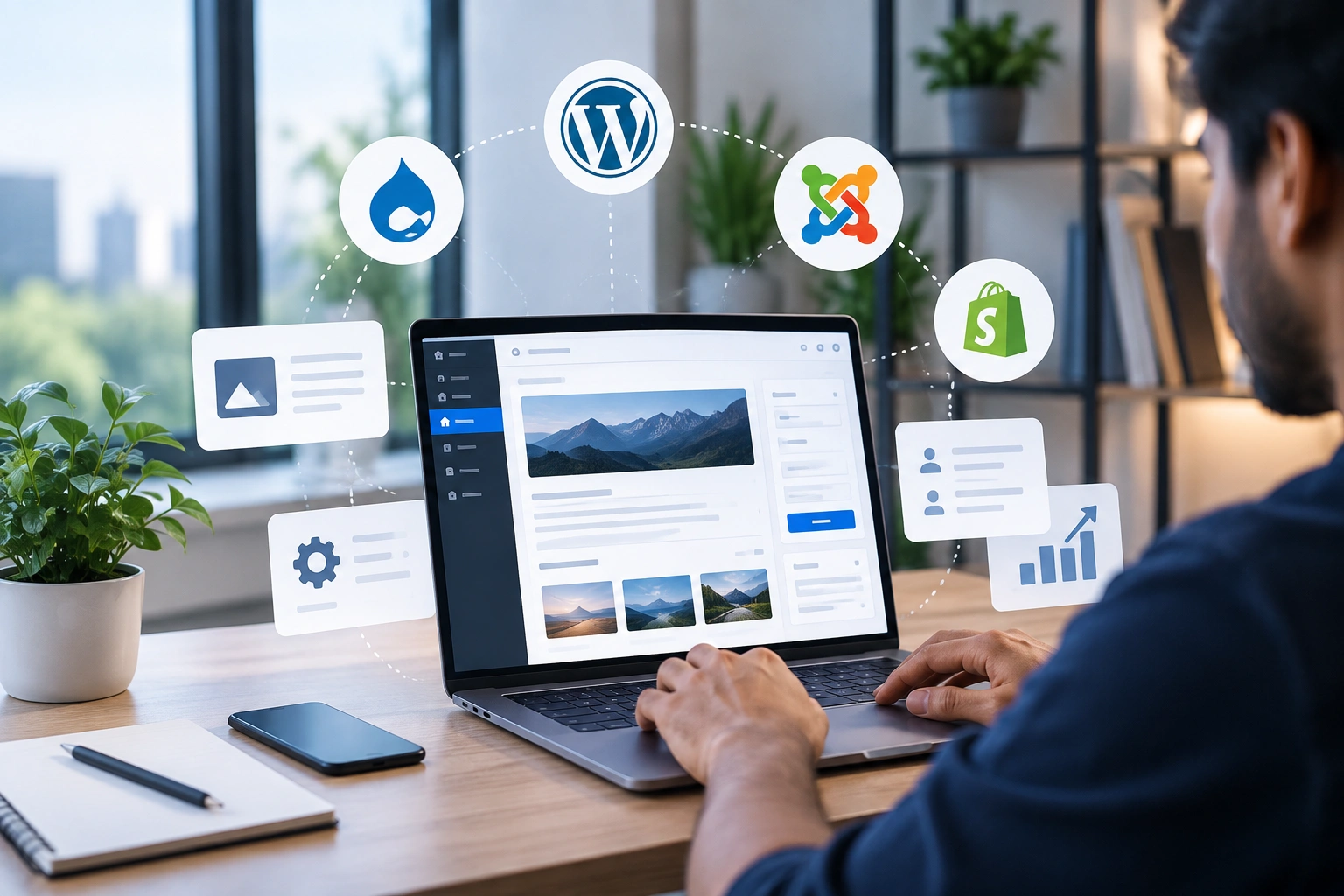
Popular CMS Platforms
WordPress
WordPress is widely used for business websites, blogs, publishing platforms, and content-driven websites. Its extensive ecosystem makes it suitable for businesses that require flexibility and a large range of integrations.
Drupal
Drupal is often used for complex websites requiring advanced content structures, permissions, and customization.
Joomla
Joomla provides content management capabilities for businesses and organizations that require structured website content and extensibility.
Shopify
Shopify is primarily focused on e-commerce and enables businesses to manage products, collections, content, orders, and online sales.
Custom CMS
A custom CMS can be developed when a business requires specific workflows, functionality, integrations, or content structures that existing platforms cannot efficiently provide.
Custom CMS vs Ready-Made CMS
Choosing between a custom CMS and an existing platform depends on the project's requirements.
| Feature | Ready-Made CMS | Custom CMS |
|---|---|---|
| Development Time | Usually faster | Usually longer |
| Initial Cost | Often lower | Usually higher |
| Customization | Platform-dependent | Highly flexible |
| Unique Workflows | May require customization | Can be built specifically |
| Maintenance | Platform/plugin dependent | Requires dedicated maintenance |
| Scalability | Depends on platform | Can be architected for requirements |
WordPress CMS Development
WordPress is one of the most widely used CMS platforms for business websites,
blogs, publishing platforms, and content-driven websites. Its extensive plugin
ecosystem and customization options make it suitable for businesses that need
a flexible website management solution.
- Easy-to-use content management dashboard
- Large ecosystem of themes and plugins
- SEO-friendly website structure with the right configuration
- Suitable for blogs, business websites, and service websites
- Supports custom themes and functionality
- Can integrate with analytics, CRM, forms, and marketing tools
Features to Look for in a CMS
A modern CMS should make website management simple while supporting technical and marketing requirements.
Important features include:
Responsive administration dashboard
User role management
Media management
SEO controls
Search functionality
Content scheduling
Form management
Analytics integration
Security controls
Backup capabilities
API support
Performance optimization
Multilingual support when required
The exact feature set should depend on the website's purpose and business workflow.
CMS Development and SEO
A CMS plays an important role in technical and on-page SEO.
For example, an SEO-friendly CMS should make it possible to manage title tags, meta descriptions, headings, URLs, internal links, image optimization, redirects, canonical tags, and structured data.
It should also support a clean website architecture that allows search engines to discover and understand important pages.
For content-heavy websites, CMS functionality can also support an effective content strategy by making it easier to publish new articles, update existing pages, and create landing pages.
CMS Development for Businesses in Chennai and India
Businesses in Chennai and across India are increasingly investing in websites that support lead generation, e-commerce, content marketing, and digital customer experiences.
A CMS development company in Chennai can help businesses create websites based on their industry, audience, technology requirements, and growth objectives.
For businesses serving customers across India, a scalable CMS can also support multiple locations, regional landing pages, multilingual content, and location-specific marketing campaigns.
How to Choose the Right CMS Development Company
Before selecting a development partner, businesses should evaluate several factors.
Check Technical Expertise
Review the company's experience with the CMS platform, programming technologies, integrations, hosting environments, and security practices required for the project.
Review Previous Projects
Look at previous websites to understand the company's approach to design, functionality, performance, and usability.
Understand the Development Process
Ask about requirements gathering, UI/UX design, development, testing, deployment, and post-launch support.
Consider SEO Requirements
The development team should understand how website architecture and CMS functionality affect crawling, indexing, page performance, and search visibility.
Evaluate Support and Maintenance
A website requires ongoing updates, security improvements, backups, bug fixes, and technical support after launch.
Why Choose Webdoux for CMS Development?
Webdoux helps businesses build digital experiences that combine website development, user experience, SEO, and digital marketing requirements.
As a CMS development company, Webdoux can help businesses with CMS website development, customization, integrations, performance optimization, and ongoing improvements.
The goal is not simply to build a website but to create a manageable digital platform that supports content publishing, search visibility, lead generation, and business growth.
Frequently Asked Questions (FAQs)
What is a CMS development company?
A CMS development company specializes in building, customizing, integrating, and maintaining content management systems for businesses and organizations.
Which CMS is best for a business website?
There is no single CMS that is ideal for every business. The right choice depends on the website's content requirements, functionality, scalability, budget, integrations, and maintenance needs.
How much does CMS development cost?
CMS development costs vary depending on factors such as website size, design complexity, custom functionality, integrations, number of pages, e-commerce requirements, and ongoing maintenance.
Can a CMS website be SEO-friendly?
Yes. A properly developed CMS can support SEO features such as optimized URLs, metadata, headings, redirects, canonical tags, structured data, image optimization, and internal linking.
Can an existing website be migrated to a new CMS?
Yes. CMS migration can move content, media, users, and other website components to a new platform. Proper URL mapping and redirects are important to reduce potential SEO issues during migration.
Conclusion
A well-developed CMS gives businesses greater control over their websites and digital content. It can simplify content management, improve publishing workflows, support SEO, and provide a foundation for future growth.
Whether you need a business website, e-commerce platform, content-driven website, or custom digital solution, choosing the right CMS architecture and development partner is an important part of the project.
Looking for a CMS development company to build or upgrade your business website? Webdoux can help you plan, develop, optimize, and maintain a CMS solution aligned with your business requirements.
Latest Posts